
Photo by Andrew Klonaris on Unsplash
A global markets summary, for
Australian investors
Rising unemployment, Trump’s rejection of Iran’s Hormuz reopening proposal and an imminent RBA rate decision combined to create a difficult backdrop for Australian markets this week, with the ASX falling to its lowest close since June as bond yields rose and rate expectations tightened further.
Five Key Developments:
-
Australian unemployment rate rises to 4.6%
Australia’s unemployment rate rose to 4.6% in August, up from 4.4%, reaching its highest level of the post-COVID period. The participation rate increased 0.2 percentage points to 67.1%, while underemployment actually edged down to 6.2%. The result points to a gradually loosening labour market as growth in the labour force outpaces employment.
-
Australian economy adds 39.5K new jobs
Employment increased by approximately 39,500 in August, considerably stronger than the unemployment headline initially suggests. However, the composition was weaker: part-time employment increased by around 46,000, while full-time employment declined by around 6,000. Hours worked increased 0.7%. The combination of rising employment and rising unemployment reflects the increase in labour-force participation.
-
President Trump rejects Iran’s proposal to reopen the Strait of Hormuz
President Trump rejected an Iranian proposal that would have reopened the Strait of Hormuz within seven days as part of a wider agreement to end the conflict. Iran’s proposal linked reopening the Strait with an end to US military action and the blockade of Iranian ports. Negotiations have not necessarily ended, but the rejection prolongs uncertainty surrounding a critical global energy transit route.
-
US consumer sentiment increases to 48.1 vs 47.4 expected
US consumer sentiment was revised upward to 48.1 in September, above the expected 47.4 and preliminary reading of 47.8. However, the apparent improvement needs context: sentiment was 51.7 in August, meaning household confidence still deteriorated materially over the month. Inflation and higher energy costs remain important concerns for US consumers.
-
Canadian retail sales decline by 0.7% m/m
Canadian retail sales declined 0.7% month-on-month in July to C$73.7 billion, with sales falling in eight of nine subsectors. Core retail sales also declined 0.7%, while inflation-adjusted sales volumes fell a larger 1.1%. General merchandise retailers recorded the largest core decline, falling 1.9%.
Australian Focus
RBA Hike Looms as Labour Market and Hormuz Uncertainty Weigh
Australia’s labour market data this week told a more nuanced story than the headline unemployment rate suggests. Employment growing by 39,500 is not a weak number, but the shift toward part-time work and the rise in participation pushing unemployment to 4.6% gives the RBA a picture of a labour market that is gradually loosening rather than deteriorating sharply. That distinction matters for policy timing, but markets are not reading it as a reason to pause, with the RBA widely expected to raise the cash rate to 4.6% this week.
Trump’s rejection of Iran’s Hormuz reopening proposal removed one of the more constructive scenarios markets had been watching, prolonging energy supply uncertainty and keeping oil prices elevated at a moment when global central banks are already struggling with inflation persistence. US consumer sentiment deteriorating materially over the month despite a marginal beat on expectations, and Canadian retail sales falling across almost every subsector, add to a global picture of consumers feeling the sustained pressure of higher rates and energy costs. The ASX reflected all of this, falling to its lowest close since June with banks, resources and energy all under pressure, while technology names WiseTech and selected healthcare names provided the only meaningful pockets of strength. Australian wool prices hitting 2,033¢/kg and grain prices holding firm offer some insulation for the agricultural sector against the broader weakness.
Australian Agricultural Wrap Up
Australian agriculture remains broadly supported by firm commodity prices and improving southern seasonal conditions. APW Wheat is around A$431/t, ASW Wheat A$422/t, Feed Barley A$369/t and Canola A$806/t, while wool remains particularly strong at around 2,033¢/kg clean. ABARES forecasts a 61Mt national winter crop including 29.9Mt of wheat, with favourable conditions supporting Victoria and South Australia. Northern NSW and Queensland remain considerably drier, with NSW wheat production forecast to fall 31%, and spring rainfall remains the key variable for northern producers.
Futures Market Performance
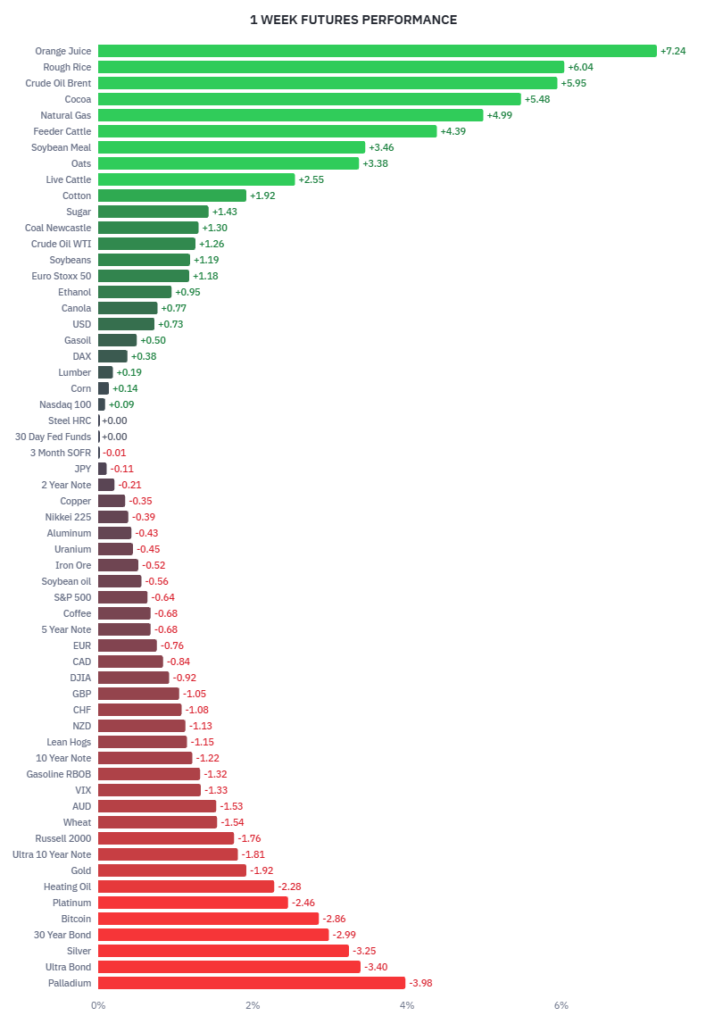
Rough rice and cocoa led commodity gains on supply concerns while precious metals fell sharply as a stronger US dollar and rising bond yields reduced demand for non-yielding assets.
Commodity markets were driven by several distinct themes this week. Rough rice surged +6.0% to an 18-month high, with weather uncertainty across major producing regions raising concerns around future supply. Cocoa gained 5.5% as dry conditions in West Africa renewed concerns over crop development and production. Precious metals moved sharply in the opposite direction, with gold, silver, platinum and palladium all declining as a stronger US dollar, rising bond yields and expectations that US interest rates will remain higher for longer reduced demand for non-yielding assets.
ASX Weekly Heatmap
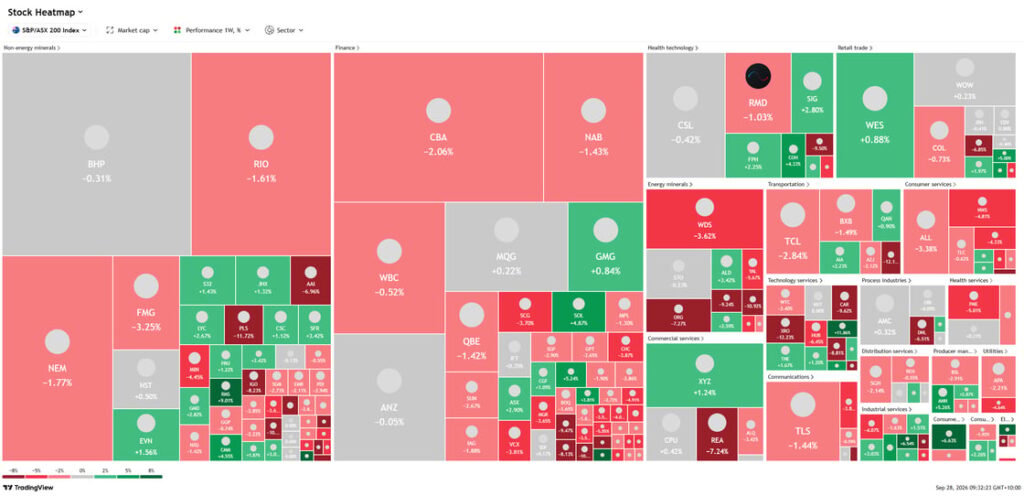
The ASX fell to its lowest close since June with banks, resources and energy all under pressure as rising bond yields and RBA hike expectations weighed broadly, while WiseTech and Sigma Healthcare provided pockets of strength.
The ASX 200 fell to 8,665 points, its lowest close since June, as rising global bond yields and expectations of another RBA rate hike weighed on equities. Higher rates particularly pressured technology, property and consumer stocks, while weaker copper and lithium prices dragged on resources. Despite unemployment rising to 4.6%, markets continue to expect the RBA to tighten as inflation remains the dominant concern. Across the week, CBA (-2.06%), NAB (-1.43%), Fortescue (-3.25%) and Woodside (-3.62%) weakened, while WiseTech (+2.40%), Sigma Healthcare (+2.80%) and Wesfarmers (+0.88%) provided pockets of strength.
If any of this week’s developments raise questions about your portfolio, please get in touch.
Related Insights
The Federal Reserve, Bank of Japan and RBNZ all raised interest rates this week in a synchronised gl...
Drone attacks on Saudi Arabia's East-West oil pipeline drove fuel prices sharply higher this week, c...

Australian GDP beat expectations and US payrolls surged to 162K this week, reviving the prospect of...