
Photo by Yang-Chen Lin on Unsplash
A global markets summary, for
Australian investors
Drone attacks on Saudi Arabia’s East-West oil pipeline added a significant new dimension to the energy supply crisis this week, driving fuel prices sharply higher at a time when Hormuz flows are already heavily constrained, while accelerating US core inflation and an ECB rate hike reinforced that the global tightening cycle has further to run.
Five Key Developments:
1. Canadian CPI m/m -0.1%
Canadian inflation softened slightly in August, with headline CPI falling 0.1% month-on-month while remaining 3.0% higher over the year. On a seasonally adjusted basis, prices actually increased 0.2%. Gasoline inflation moderated compared with July, while higher rents and travel costs continued to provide upward pressure. The result suggests underlying inflation remains relatively persistent despite the negative headline monthly print.
2. GBP Claimant Count Change rises to 27.8K
UK labour-market data weakened over the week, with Claimant Count Change rising to 27.8K, indicating a further increase in the number of people claiming unemployment-related benefits. The softer employment backdrop weighed on sterling during the week as markets assessed the outlook for UK monetary policy. GBP finished the period weaker against the US dollar, consistent with the broader strength in the USD.
3. US Federal Reserve increases interest rates to 4%
The Federal Reserve raised the federal funds target range by 25 basis points to 3.75–4.00%, with the decision receiving a unanimous 12–0 vote. The Fed cited resilient domestic spending, strong productivity and investment, alongside inflation that remains elevated. The move represents a renewed tightening of US monetary policy, with the Fed stating that higher rates should support a more timely return of inflation towards its 2% target.
4. NZ GDP rises marginally to 0.2%
New Zealand’s economy expanded by just 0.2% in the June quarter, slowing considerably from the revised 0.9% expansion recorded in March. The result points to relatively subdued economic momentum despite the economy remaining in positive growth territory. The weak GDP backdrop contrasts with elevated inflation, with June-quarter CPI previously recorded at 4.1% year-on-year, leaving the RBNZ facing a difficult balance between inflation and growth.
5. Bank of Japan increases interest rates to <1.25%
The Bank of Japan increased its policy rate by 25 basis points to 1.25%, taking Japanese rates to their highest level in roughly three decades. The move continues Japan’s transition away from its long period of exceptionally accommodative monetary policy as the Bank responds to persistent inflation pressures. Despite the hike, the yen weakened sharply over the week, falling 1.90% on the heatmap, suggesting markets focused on the potential pace of further tightening rather than the increase itself.
Australian Focus
Synchronised Global Tightening Reshapes the Rate Landscape
The simultaneous tightening from the Fed, BOJ and RBNZ this week marks a significant moment in the global rate cycle. The Fed hiking unanimously to 4% with language pointing to further increases, Japan reaching its highest rate in three decades, and New Zealand continuing its own tightening path despite GDP slowing sharply to 0.2% all point to a world where central banks are prioritising inflation control even as growth momentum softens. The stronger USD that accompanied these moves added pressure across currencies and commodity markets, with agricultural softs selling off heavily while metals held up better.
For Australian investors, the global tightening environment keeps the RBA’s own path firmly in focus. The ASX reflected the consequent repricing of rate-sensitive assets, with Goodman Group and Xero falling sharply as higher global bond yields compressed longer-duration valuations. Healthcare was the standout, with CSL gaining strongly, while selected banks performed well and resources were broadly resilient on metals strength. Australian agricultural prices held steady with livestock strengthening and grain prices firm, while ABARES’ winter crop forecast of around 61Mt remains historically strong despite below-average conditions across northern NSW and Queensland.
Australian Agricultural Wrap Up
Australian agricultural prices were broadly steady this week. APW Wheat was A$426/t, ASW Wheat A$417/t, Feed Barley A$366/t, Canola A$802/t and Sorghum A$429/t. Livestock strengthened, with the EYCI at 1,002¢/kg and Trade Lamb at 1,192¢/kg, both up 1% for the week. Wool eased to 1,878¢/kg clean, while the Cotlook A Index fell 3% to US 96.0¢/lb. ABARES expects the winter crop to reach around 61Mt, still historically strong despite being below last season, with timely rainfall supporting Victoria and southern NSW while northern cropping regions remain considerably drier.
Futures Market Performance
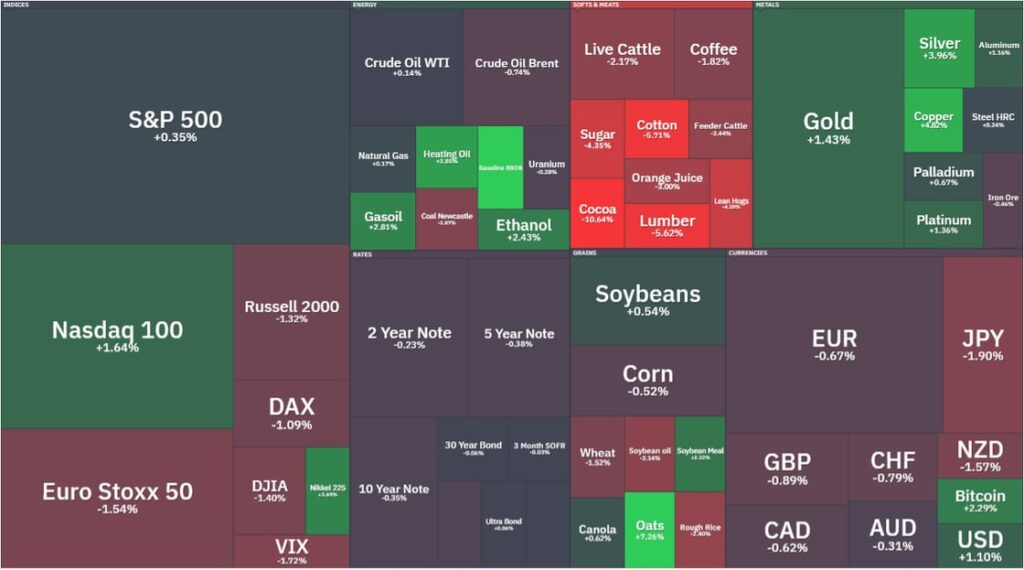
Metals led commodity gains with copper and silver both advancing, while agricultural softs sold off heavily on a stronger USD and improving weather conditions, and energy markets were broadly mixed.
Commodities were sharply divided this week. Metals led gains, with Copper +4.82%, Silver +3.96% and Gold +1.43%, as precious metals recovered following the Fed hike and easing oil prices reduced inflation and yield pressure. Energy was mixed: WTI +0.14%, Brent –0.74%, while Gasoil +2.81% and Ethanol +2.43%. Agriculture was dominated by heavy selling across softs: Cocoa –10.64%, Cotton –5.71%, Lumber –5.62% and Sugar –4.35%, reflecting improving weather, a stronger USD and technical selling. Grains were mixed, led by Oats +7.26%, while Wheat fell –1.52%.
ASX Weekly Heatmap
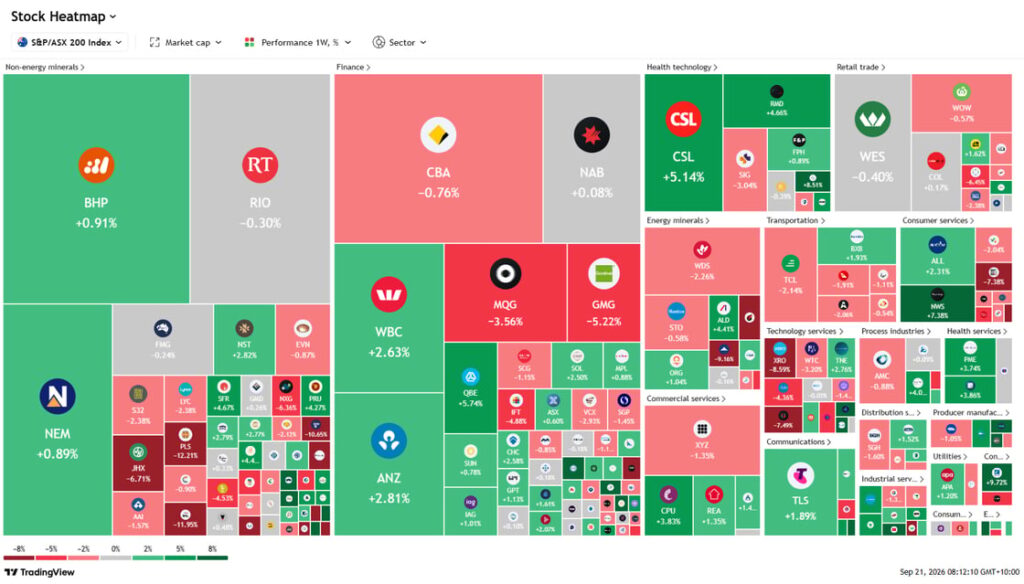
The ASX was sharply divided with healthcare and selected banks outperforming while rate-sensitive growth names including Goodman Group and Xero fell heavily as higher global bond yields compressed longer-duration valuations.
The ASX was sharply divided between healthcare, banks and weaker growth stocks. CSL +5.14% was the standout large-cap performer, while financials diverged: ANZ +2.81%, Westpac +2.63% and QBE +5.74%, against CBA –0.76% and Macquarie –3.56%.Resources were comparatively resilient, with BHP +0.91% and Newmont +0.89%, supported by the strength in metals. The major weakness came from rate-sensitive and technology names, including Goodman Group –5.22% and Xero –8.59%, as higher global bond yields and renewed Fed tightening pressured longer-duration valuations. Overall, the week favoured selected banks, healthcare and resources over growth exposures.
If any of this week’s developments raise questions about your portfolio, please get in touch.
Related Insights

Australia's unemployment rate hit its highest post-COVID level and Trump rejected Iran's Hormuz reop...

Drone attacks on Saudi Arabia's East-West oil pipeline drove fuel prices sharply higher this week, c...

Australian GDP beat expectations and US payrolls surged to 162K this week, reviving the prospect of...