Photo by Suhail Muhammed on Unsplash
A global markets summary, for
Australian investors
Drone attacks on Saudi Arabia’s East-West oil pipeline added a significant new dimension to the energy supply crisis this week, driving fuel prices sharply higher at a time when Hormuz flows are already heavily constrained, while accelerating US core inflation and an ECB rate hike reinforced that the global tightening cycle has further to run.
Five Key Developments:
1. Saudi oil pipeline closed due to attacks
Saudi Arabia shut its critical East-West oil pipeline following drone attacks, threatening a major alternative export route while flows through the Strait of Hormuz remain heavily constrained. The pipeline had been carrying around 4 million barrels per day, equivalent to roughly 4% of global supply, to the Red Sea. The disruption drove another sharp rise in oil and fuel prices as markets assessed how quickly the pipeline can be repaired.
2. European Main Refinancing Rate rises to 2.65%
The ECB raised all three key interest rates by 25 basis points, taking the Main Refinancing Rate to 2.65%. The decision was driven by renewed inflationary pressure from the Middle East conflict, with the ECB now expecting headline inflation to average 3.0% in 2026. Policymakers also upgraded economic growth forecasts, giving the ECB greater scope to tighten policy despite elevated geopolitical uncertainty.
3. US Core PPI steady at 0.2% m/m
US Core PPI increased 0.2% m/m in August, below the 0.3% expected and down from a revised 0.3% in July. However, headline producer prices rose a stronger 0.4%, driven by a 1.1% increase in goods prices as energy costs surged. The mixed result shows underlying producer inflation remains relatively contained, but rapidly rising fuel costs are creating renewed inflationary pressure further up the supply chain.
4. US Unemployment claims steady at 206K
US initial unemployment claims remained low at 206K, down marginally from the previous week’s revised 207K. The four-week average also eased to 206K, suggesting there has been little meaningful increase in layoffs despite signs of slower employment growth elsewhere. The continued resilience of the labour market gives the Federal Reserve another reason to remain cautious about easing policy while inflation remains above target.
5. US Core CPI rises to 0.3% m/m
US Core CPI accelerated to 0.3% m/m in August, while headline CPI rose 0.4% and remained elevated at 3.4% y/y. Importantly, the acceleration was not solely an energy story, with underlying inflation strengthening even after food and energy were excluded. Combined with higher producer prices, the release increased expectations that the Federal Reserve may need to raise rates again at this week’s meeting.
Australian Focus: Energy Supply Shock Compounds Difficult Inflation Picture
The Saudi pipeline attack was the week’s defining event, and its timing could not have been worse for inflation-watchers. With Hormuz already constrained and Saudi inventories at Yanbu estimated to cover only five to seven days of exports without the pipeline, the supply disruption is not a tail risk but an active constraint on global oil flows. Gasoline, WTI and Brent all surged above 8%, adding fresh upward pressure to headline inflation at the precise moment central banks were hoping energy costs would ease.
For Australian investors, the consequences spread across multiple fronts simultaneously. The ECB hiking to 2.65% and US core CPI accelerating to 0.3% m/m independently of energy costs confirm that inflation is not purely a supply-side story, which strengthens the case for the RBA to follow through on further tightening. The ASX reflected the difficulty of that environment, with resources, financials and healthcare all selling off heavily while only energy names Santos and Woodside and defensives like Telstra managed to finish higher. Australian agricultural prices remain at historically strong levels, with beef production forecasts at near-record highs and cotton and wool prices well above year-ago levels, providing some insulation for the rural sector against the broader market weakness.
Australian Agricultural Wrap Up
Australian agricultural prices remain at historically attractive levels based on the most recent ABARES data available. APW Wheat was A$425/t, ASW Wheat A$415/t, Feed Barley A$374/t, Canola A$799/t and Sorghum A$430/t. Livestock has remained strong, while wool’s Eastern Market Indicator was 1,890¢/kg clean and the Cotlook Cotton Index 101.5 US¢/lb, both around 40% and 30% higher respectively than a year earlier. ABARES forecasts Australian beef production at 2.9Mt for the year, its second-highest level on record, while wool prices are expected to remain elevated.
Futures Market Performance
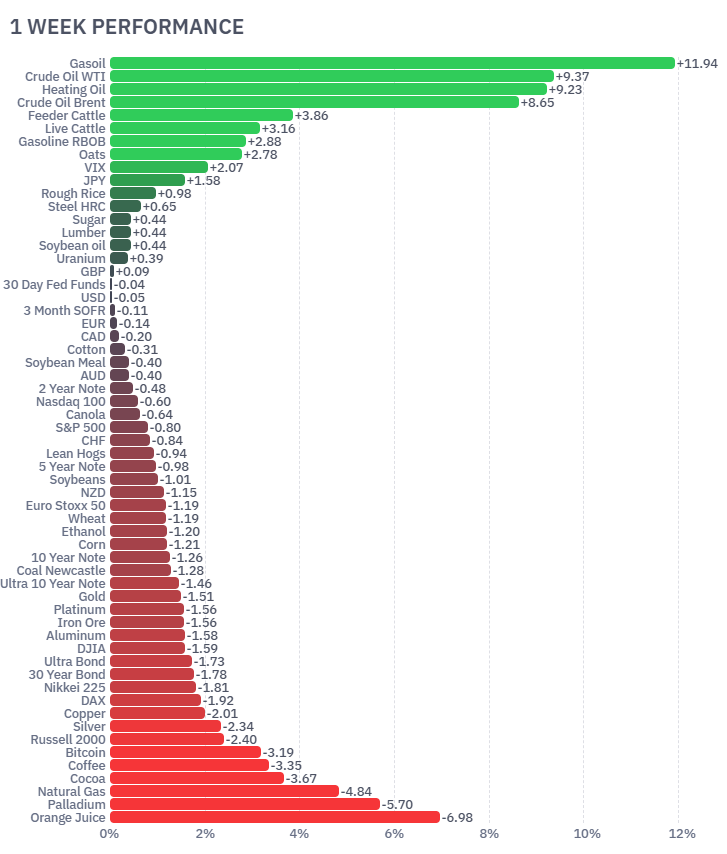
Energy dominated global markets with gasoline, WTI and Brent all surging above 8% following the Saudi pipeline attack, while precious metals weakened despite elevated geopolitical risk as rising yields weighed on the complex.
The standout global move was energy. Gasoline (+11.94%), WTI (+9.37%), Heating Oil (+9.23%) and Brent (+8.65%) surged as the attack on Saudi Arabia’s East-West pipeline threatened as much as 4% of global oil supply, at a time when Hormuz flows are already heavily constrained. Saudi inventories at Yanbu were estimated to cover only five to seven days of exports without the pipeline restarting.
Agricultural futures were comparatively subdued, while Feeder Cattle (+3.86%) and Live Cattle (+3.16%) were notable positives. Precious metals weakened despite geopolitical risk, with Gold (-1.51%), Silver (-2.34%)and Palladium (-5.70%), as rising inflation expectations and bond yields weighed on the complex.
ASX Weekly Heatmap
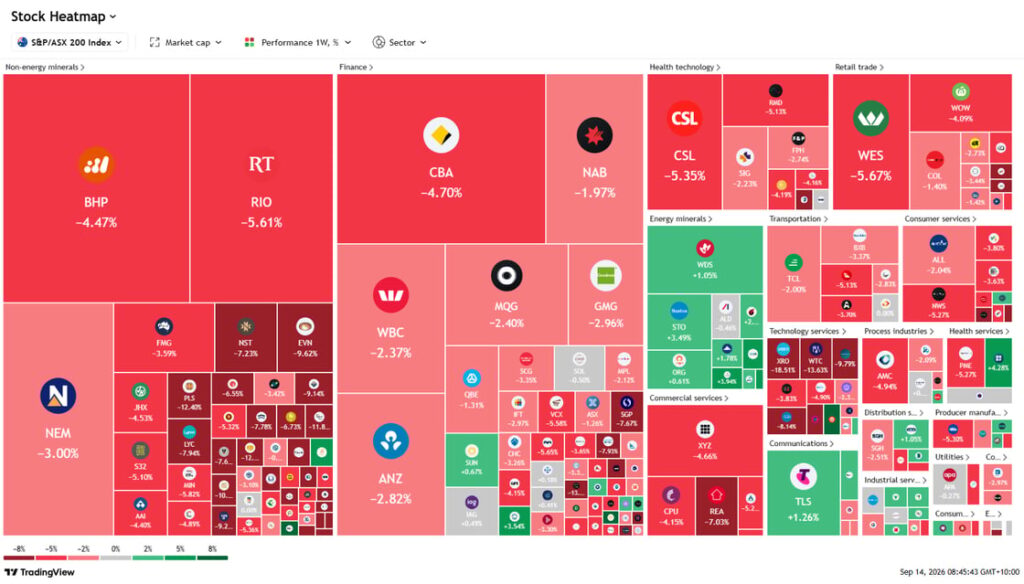
The ASX had a difficult week with broad selling across resources, financials and healthcare, while energy names Santos and Woodside and defensive stock Telstra were among the few to finish higher.
The ASX had a difficult week, with selling widespread across the major sectors. Resources were particularly weak, with Rio Tinto (-5.61%), BHP (-4.47%), Newmont (-3.00%), Fortescue (-3.59%) and Northern Star (-7.23%) all lower. Financials also reversed sharply, led by CBA (-4.70%), ANZ (-2.82%), Westpac (-2.37%) and NAB (-1.97%). Elsewhere, CSL (-5.35%) and Wesfarmers (-5.67%) added to the weakness, while energy was one of the few areas of strength as higher oil prices supported Santos (+3.49%) and Woodside (+1.05%). Telstra (+1.26%) also finished higher.
If any of this week’s developments raise questions about your portfolio, please get in touch.
Related Insights

Australian GDP beat expectations and US payrolls surged to 162K this week, reviving the prospect of...

Australian CPI surprised to the upside at 1.0% m/m while Fed Chair Warsh delivered a hawkish Jackson...

Australian unemployment rose to 4.5% and wages continued to moderate, signalling the labour market i...