
Photo by Daniel Morton-Jones on Unsplash
A global markets summary, for
Australian investors
Stronger-than-expected Australian GDP and a sharp rebound in US payrolls dominated the week, bringing further RBA tightening back into focus domestically while reinforcing the resilience of the US economy and reducing the case for Federal Reserve easing.
Five Key Developments:
1. European Core CPI retreats to 2.4% y/y
Eurozone Core CPI eased to 2.4% y/y in August from 2.5%, indicating that underlying inflationary pressures continue to moderate. However, headline inflation moved sharply in the opposite direction, rising to 3.3% as higher energy prices fed through to consumers. Services inflation also eased from 3.3% to 3.0%, leaving the ECB balancing improving underlying inflation against the renewed energy-driven increase in headline prices.
2. Australian GDP rises 0.4% q/q ahead of expectations
Australian GDP grew 0.4% q/q in the June quarter, slightly ahead of the 0.3% expected and up 2.1% over the year. The result showed the economy continuing to expand despite restrictive financial conditions, although growth remains relatively subdued. Household consumption increased, while GDP per capita was flat, highlighting that population growth continues to contribute significantly to overall economic expansion.
3. RBNZ raises interest rates to 2.75%
The RBNZ increased the Official Cash Rate by 25bps to 2.75%, continuing the gradual removal of monetary stimulus. Annual inflation reached 4.1% in the June quarter, largely due to higher fuel prices following the Middle East conflict, although underlying inflation measures remain considerably better behaved. Importantly, the RBNZ indicated rates may need to increase further if inflation risks persist.
4. Canada sheds 41.7K jobs
Canada’s labour market weakened considerably in August, with employment falling 41.7K, reversing part of the strong gains recorded over previous months. The unemployment rate remained unchanged at 6.4%, while average hourly wage growth slowed to 2.0% y/y. The weakness was concentrated across younger workers and several service industries, providing further evidence that Canadian labour-market conditions are gradually cooling.
5. US Non-Farm Employment Change jumps by 162K
US Non-Farm Payrolls rose by 162K in August, substantially above the 56K expected, while the unemployment rate remained steady at 4.1%. The result represented a sharp improvement from July’s revised 21K increase and was led by food services and local government education. The stronger employment result reinforces the resilience of the US economy and reduces the immediate case for easier Federal Reserve policy.
Australian Focus: GDP Beat and US Payrolls Revive RBA Tightening Talk
Two strong data points defined the week. Australian GDP growing 0.4% q/q ahead of expectations and US payrolls jumping to 162K against a forecast of just 56K together shifted the mood from cautious patience toward renewed concern that policy may need to do more work. Markets are now pricing around a 28% chance of two further RBA hikes before year end, and with the RBNZ raising to 2.75% and flagging further increases if inflation persists, the regional tightening narrative has reasserted itself.
For Australian investors, the GDP result is a double-edged outcome. An economy continuing to expand despite restrictive conditions is broadly positive, but it reduces the RBA’s justification for sitting still. The ASX reflected that tension through sharp sector rotation, with banks rallying strongly on the prospect of higher rates for longer while miners fell heavily, with BHP and FMG among the largest decliners. Telstra was a standout performer. Canadian job losses and European headline inflation rising on energy costs added to a complex global picture, while Australian agricultural markets strengthened across the board with wheat, canola and livestock all gaining on improved seasonal conditions across southern Australia.
Australian Agricultural Wrap Up
Australian agricultural markets had a strong week, with both grain and livestock prices generally higher. APW Wheat rose 4% to A$425/t, ASW Wheat gained 3% to A$415/t, Feed Barley rose 1% to A$374/t and Canola increased 3% to A$799/t, while Sorghum held at A$430/t. Livestock also strengthened, with the EYCI rising 3% to 985¢/kg cwt, Mutton up 4% to 863¢/kg and Trade Lamb up 1% to 1,172¢/kg. Wool gained 2% to 1,890¢/kg clean, while the Cotlook Cotton Index rose 3% to 101.5 US¢/lb. The seasonal outlook remains highly varied, with better conditions across southern Australia contrasting with persistent dryness across northern NSW and southern Queensland.
Futures Market Performance
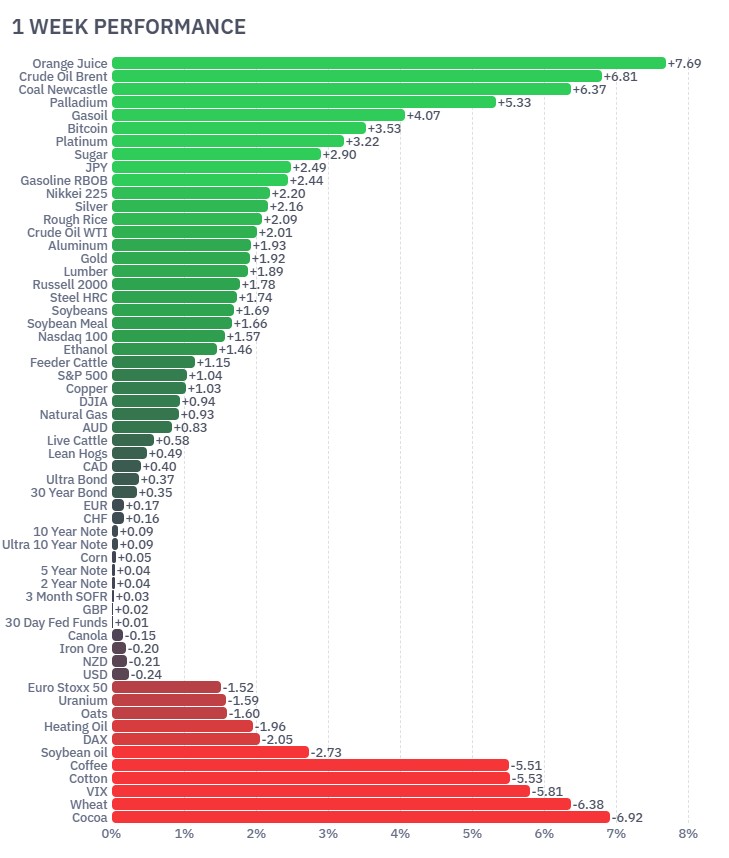
Oil gained on renewed Middle East supply concerns while agricultural futures were mixed, with soybeans higher and wheat, cocoa and coffee falling sharply on profit taking.
Oil was a notable mover, with Brent (+6.81%) and WTI (+2.01%) supported by renewed Middle East supply concerns and disruptions to Russian refining capacity. Agricultural futures were mixed, with Soybeans (+1.69%) and Feeder Cattle (+1.15%) higher, while Wheat (-6.38%), Cotton (-5.53%), Coffee (-5.51%) and Cocoa (-6.92%) fell sharply due to profit taking.
ASX Weekly Heatmap
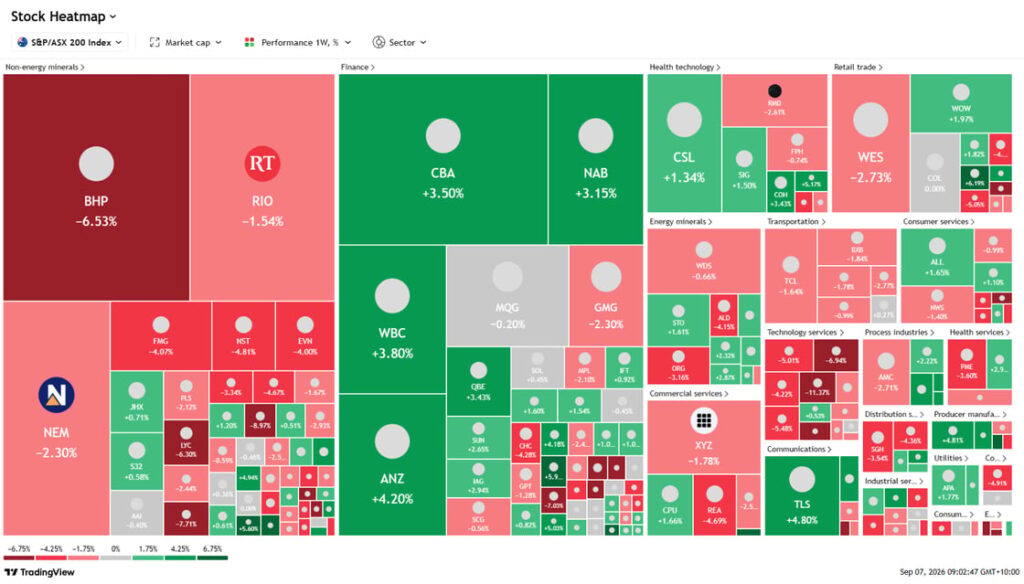
The ASX saw heavy sector rotation with banks rallying strongly on higher-for-longer rate expectations while miners fell sharply, with BHP, FMG and Northern Star among the largest decliners.
The ASX was heavily divided this week, with financials rallying while the major miners fell sharply. ANZ (+4.20%), WBC (+3.80%), CBA (+3.50%) and NAB (+3.15%) all strengthened, providing significant support to the index. Resources moved sharply lower, led by BHP (-6.53%), Northern Star (-4.81%), FMG (-4.07%) and Newmont (-2.30%). Elsewhere, Telstra (+4.80%) performed strongly, while consumer and technology names were generally weaker. Overall, the index disguised substantial sector rotation, with strength in the banks offsetting considerable weakness across the resources sector.
If any of this week’s developments raise questions about your portfolio, please get in touch.
Related Insights

Drone attacks on Saudi Arabia's East-West oil pipeline drove fuel prices sharply higher this week, c...
Australian CPI surprised to the upside at 1.0% m/m while Fed Chair Warsh delivered a hawkish Jackson...

Australian unemployment rose to 4.5% and wages continued to moderate, signalling the labour market i...