
Photo by Enguerrand Photography on Unsplash
A global markets summary, for
Australian investors
A strong US manufacturing print, resilient labour market data and softening wage growth combined to keep Federal Reserve policy expectations finely balanced this week, while domestically all eyes turned to the RBA meeting with markets expecting the cash rate to hold at 4.35%.
Five Key Developments:
1. US Manufacturing PMI increases to 55.6 vs 53.3 previous
US manufacturing strengthened considerably in July, with the ISM Manufacturing PMI rising to 55.6 from 53.3, its highest level in more than four years and above expectations of 54.0. New orders continued to expand and manufacturing employment returned to growth for the first time in 33 months. However, input prices remained elevated, suggesting the stronger economy is still accompanied by inflationary pressure and potentially giving the Federal Reserve less room to ease policy.
2. NZ unemployment rate rises to 5.6%
New Zealand’s unemployment rate increased to 5.6% in the June quarter, its highest level since 2015, despite employment actually increasing by 0.5%. The deterioration largely reflected increased labour-force participation, while the broader underutilisation rate climbed to 13.8%. The weak labour market highlights the difficult position facing the RBNZ, with economic conditions remaining soft while inflation is still running above its target range.
3. US average hourly earnings rise just 0.1% m/m
US wage growth moderated during July, with average hourly earnings increasing by just 0.1% month-on-month, below expectations. The softer wage result is important for the inflation outlook, as slowing labour costs should gradually reduce pressure across the services sector. However, this was balanced against other stronger US economic data during the week, particularly manufacturing, leaving the outlook for Federal Reserve policy finely balanced.
4. US unemployment rate declines to 4.1%
The US unemployment rate unexpectedly declined to 4.1%, providing further evidence that the labour market remains resilient despite signs of slowing wage growth. The combination of relatively low unemployment and stronger manufacturing activity suggests the US economy continues to perform reasonably well. For markets, the stronger labour backdrop reduces the urgency for the Federal Reserve to lower interest rates, particularly while underlying inflation pressures remain elevated.
5. RBA expected to hold rates at 4.35% tomorrow
The RBA meets tomorrow, with expectations favouring the cash rate remaining unchanged at 4.35%. Importantly, the June-quarter inflation report was softer than expected, with underlying inflation undershooting forecasts and causing markets to reduce expectations for another rate increase. A hold would provide some relief for households and businesses after the aggressive tightening earlier this year, although the RBA is likely to retain a cautious stance given the continued strength of Australia’s labour market.
Australian Focus: Australian CPI and RBA Cuts
The US data this week told two stories pulling in opposite directions. Manufacturing hitting its strongest reading in four years and unemployment declining to 4.1% point to an economy with real momentum, while wage growth slowing to just 0.1% m/m provides the Fed with some cover to stay patient. The net result is a central bank that has no clear reason to move in either direction, which markets are broadly comfortable with.
For Australian investors, the more immediate focus is the RBA decision. Softer underlying inflation in the June quarter has already reduced expectations for another hike, and a hold would be well received by rate-sensitive sectors. The ASX reflected that constructive mood this week, with resources leading strongly on the back of precious metals surging, technology names including WiseTech and Xero performing well, and market breadth broadening meaningfully beyond the major banks. New Zealand’s rising unemployment is a reminder that the tightening cycle has real costs, and that dynamic is worth watching as Australian labour market data evolves.
Australian Agricultural Wrap Up
Australian agricultural prices softened modestly this week, although prices remain relatively strong compared with a year ago. ABARES reported APW Wheat at A$394/t (-1%), ASW Wheat A$387/t (-1%), Feed Barley A$371/t (-1%), Sorghum A$431/t (flat) and Canola A$773/t (-5%). Livestock also eased, with the EYCI at 946¢/kg (-4%) and Trade Lamb at 1,176¢/kg (-1%), although both remain above year-ago levels. Cotton was a standout, with Cotton A Index rising 4% to 93.2 US¢/lb, while live export cattle gained 2% to 440¢/kg
Futures Market Performance
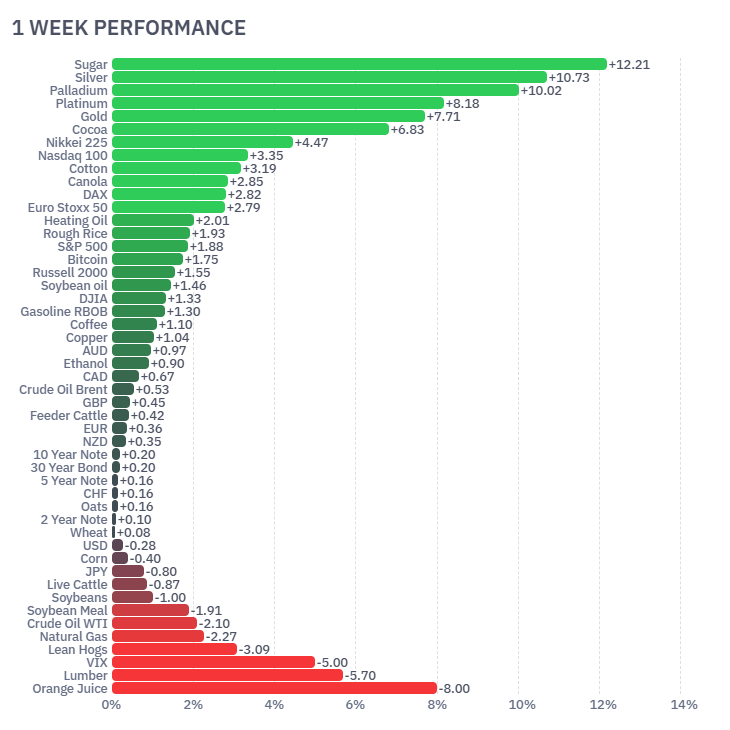
Precious metals led global commodity gains with silver, palladium, platinum and gold all surging, while oil was stable and agricultural markets were broadly constructive.
Globally, commodities were overwhelmingly stronger. Sugar (+12.21%) led the gains, followed by Silver (+10.73%), Palladium (+10.02%), Platinum (+8.18%), Gold (+7.71%) and Cocoa (+6.83%). Agricultural markets were also generally constructive, with Cotton (+3.19%), Canola (+2.85%), Rough Rice (+1.93%), Soybean Oil (+1.46%) and Coffee (+1.10%) advancing. Oil was relatively stable, while Natural Gas (-2.27%), Lean Hogs (-3.09%), Lumber (-5.70%) and Orange Juice (-8.00%) were the major laggards.
ASX Weekly Heatmap
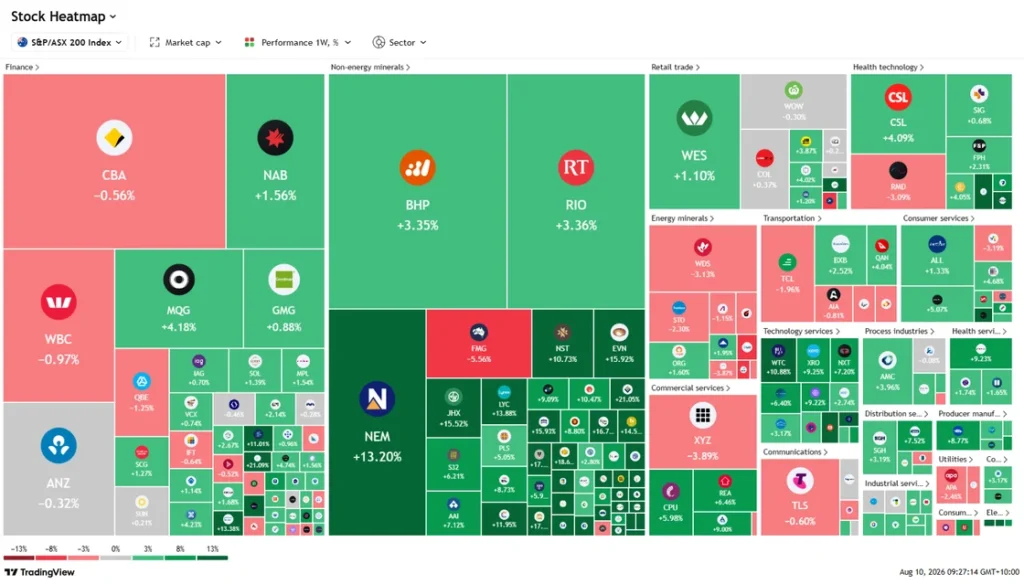
The ASX finished strongly with resources leading on precious metals strength, technology names surging on earnings momentum and market breadth improving well beyond the major banks.
The Australian sharemarket had a relatively strong week, led overwhelmingly by the resources sector. Newmont (+13.20%) surged alongside the sharp rally in precious metals, while BHP (+3.35%) and Rio Tinto (+3.36%) also strengthened. Technology was another standout, with WiseTech (+10.88%), Xero (+9.25%) and NextDC (+7.20%) all higher. Financials were mixed, with NAB (+1.56%) and Macquarie (+4.18%) outperforming while CBA (-0.56%) and WBC (-0.97%) declined. Overall, market breadth improved significantly, with strength extending well beyond the major banks into resources, technology and healthcare.
If any of this week’s developments raise questions about your portfolio, please get in touch.
Related Insights

Australia's unemployment rate hit its highest post-COVID level and Trump rejected Iran's Hormuz reop...

The Federal Reserve, Bank of Japan and RBNZ all raised interest rates this week in a synchronised gl...

Drone attacks on Saudi Arabia's East-West oil pipeline drove fuel prices sharply higher this week, c...