
A global markets summary, for
Australian investors
“US strikes on Iranian nuclear facilities escalated Middle East tensions this week, driving energy markets sharply higher while flat US core CPI reinforced the case for eventual Federal Reserve easing.
Five Key Developments:
1. US Core CPI flat at 0.0% vs 0.2% expected
Underlying US inflation unexpectedly stalled during the month, reinforcing evidence that price pressures continue to moderate despite resilient economic activity. The softer result supports expectations that the Federal Reserve may have greater flexibility to ease monetary policy over coming months, improving the outlook for both bond and equity markets.
2. US Core Retail Sales steady at 0.2% m/m
US consumer spending remained resilient, with core retail sales continuing to expand despite elevated interest rates. Stable consumption highlights the ongoing strength of household demand and suggests the broader economy remains well supported, reducing immediate recession concerns while reinforcing confidence in underlying economic activity.
3. War continues in Iran, as US attacks nuclear site
Geopolitical tensions escalated after the US launched strikes targeting Iranian nuclear facilities, further increasing uncertainty across the Middle East. While energy markets have remained relatively orderly, the conflict continues to present upside risks to oil prices, inflation and global market volatility should the situation deteriorate further.
4. Chinese retail sales rise 1.0% y/y
Chinese retail spending improved during the month, providing tentative signs that domestic consumption is beginning to stabilise following an extended period of weaker economic activity. Improving consumer demand supports confidence in China’s broader recovery, although ongoing weakness across the property sector continues to weigh on the medium-term outlook.
5. Australian MI Inflation Expectations steady at 4.7%
Australian inflation expectations remained unchanged, suggesting households continue to anticipate elevated price pressures despite recent moderation in headline inflation. Stable expectations remain an important measure for the RBA, as persistent inflation expectations could slow the pace at which monetary policy becomes more accommodative.
Australian Focus
US strikes on Iranian nuclear facilities were the week’s defining geopolitical development, pushing heating oil, Brent and WTI all up more than 8% as markets priced in renewed supply disruption risk. Flat US core CPI at 0.0% provided a constructive counterpoint, with the softer inflation read supporting expectations for greater Fed flexibility on rates, while stable Chinese retail sales offered a modest positive signal on demand.
For Australian investors, the energy surge translated directly into outperformance from Woodside and Santos on the ASX, while banks again provided solid support to the broader index. The weak spot was gold and materials names, with Newmont, Northern Star and Evolution all declining despite the geopolitical backdrop. Australian inflation expectations holding steady at 4.7% is worth noting as a reminder that the RBA’s task is not yet complete, even as global disinflationary trends continue to build.
Futures Market Performance
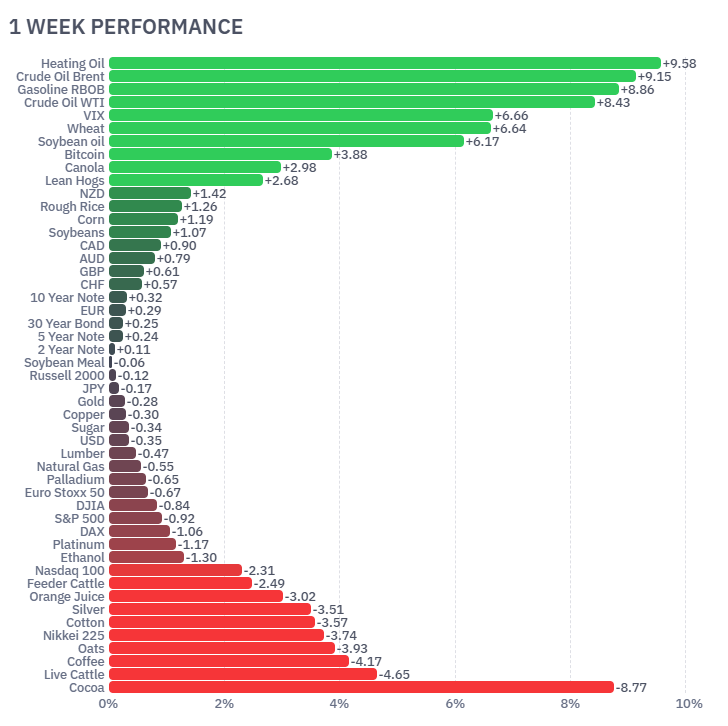
Energy markets led gains over the week as escalating tensions in the Middle East continued to support oil prices and fuel products. Heating Oil (+9.58%), Brent Crude (+9.15%), RBOB Gasoline (+8.86%) and WTI Crude (+8.43%) all rallied sharply, while the VIX (+6.66%) reflected a modest increase in investor caution. Agricultural markets were also well supported, with Wheat (+6.64%), Soybean Oil (+6.17%), Canola (+2.98%) and Corn (+1.29%) moving higher as traders priced in potential supply disruptions, higher freight costs and ongoing weather-related production risks across key growing regions.
Australian grain prices remained relatively resilient despite the offshore volatility, with APW Wheat trading around A$392/t, ASW Wheat A$381/t, Feed Barley A$382/t and Canola A$829/t. These stronger grain prices are supportive for Australian producers heading into the new season, although higher fuel and fertiliser costs continue to offset some of the benefit. Outside of agriculture, risk assets were generally weaker, with Cocoa (-8.77%), Coffee (-4.17%), Oats (-3.93%) and the Nasdaq (-2.31%) declining as investors adopted a more defensive stance.
ASX Weekly Heatmap
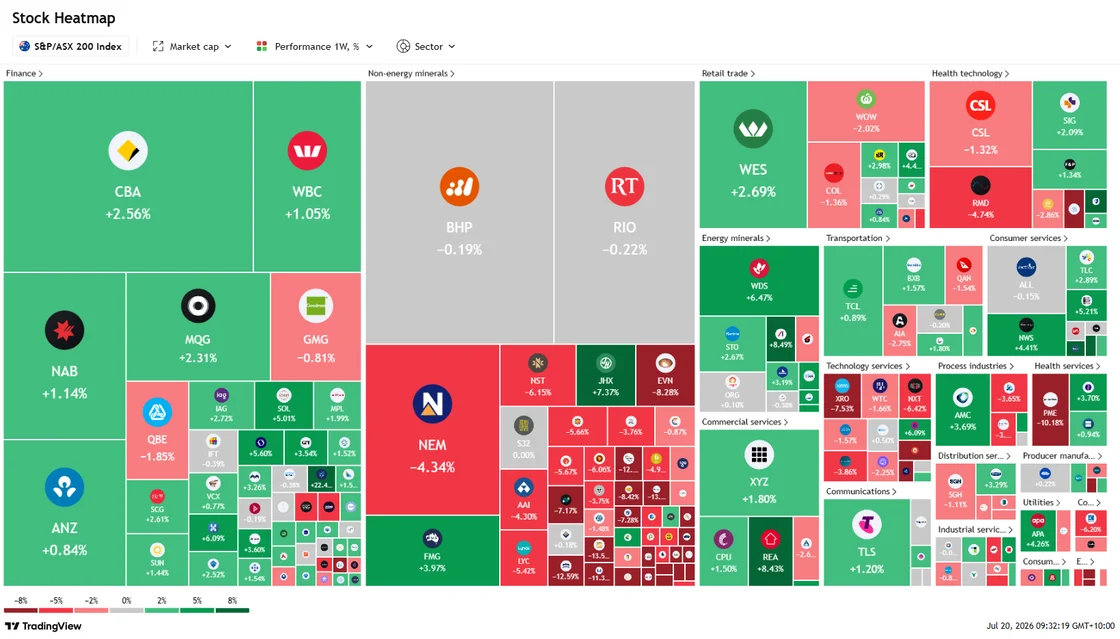
The Australian sharemarket delivered another mixed performance, with strength concentrated in financials and domestic cyclicals while resource stocks remained under pressure. Banks provided solid support, led by CBA (+2.56%), MQG (+2.31%), NAB (+1.14%) and WBC (+1.05%), while energy names benefited from the surge in oil prices, with WDS (+6.47%) and STO (+2.67%) outperforming. In contrast, miners continued to struggle, with BHP (-0.19%), RIO (-0.22%), NEM (-4.34%), NST (-6.15%) and EVN (-8.28%) weighing on the materials sector. Healthcare was mixed, with weakness in RMD (-4.74%) and PME (-10.18%) offset by gains in SIG (+2.09%), while retailers remained resilient through WES (+2.69%) despite ongoing uncertainty around consumer spending.
If any of this week’s developments raise questions about your portfolio, please get in touch.
Related Insights

Australia's unemployment rate hit its highest post-COVID level and Trump rejected Iran's Hormuz reop...

The Federal Reserve, Bank of Japan and RBNZ all raised interest rates this week in a synchronised gl...
Drone attacks on Saudi Arabia's East-West oil pipeline drove fuel prices sharply higher this week, c...