
Photo by Andrew Klonaris on Unsplash
A global markets summary, for
Australian investors
Global equity markets came under significant pressure this week as the AI trade unwound sharply and rising energy costs compounded inflation concerns, while domestically Australian employment fell by 39,300 jobs and the RBA faced a harder balancing act between sticky inflation and a weakening labour market.
Five Key Developments:
1. US CPI rises to 2.6% y/y
US headline inflation increased to 2.6% year-on-year, reinforcing concerns that inflationary pressures remain persistent. The latest reading complicates the Federal Reserve’s path towards further monetary easing, particularly as energy prices continue to rise. Markets are increasingly sensitive to inflation surprises, with higher borrowing costs potentially weighing on equity valuations and economic growth.
2. Australian labour market loses -39,300 jobs
Australia’s labour market weakened, with employment declining by 39,300 positions. The result suggests that higher interest rates are beginning to weigh more heavily on economic activity and hiring decisions. While softer employment conditions could eventually reduce domestic inflationary pressures, the RBA faces a difficult balance between controlling inflation and preventing a more pronounced economic slowdown.
3. British GDP shows margin growth of 0.1% m/m
The British economy recorded marginal growth of 0.1% month-on-month, highlighting the continued weakness in domestic economic activity. Elevated borrowing costs and subdued household demand remain significant headwinds. The modest expansion provides little evidence of a meaningful economic recovery, leaving the Bank of England balancing persistent inflationary pressures against an increasingly fragile growth outlook.
4. US Core PPI rises to 0.7% m/m ahead of expectations
US core producer prices increased by 0.7% month-on-month, exceeding market expectations and signalling renewed inflationary pressure across the production sector. Higher input costs may eventually flow through to consumer prices, particularly if businesses maintain pricing power. The result reinforces concerns that inflation could remain elevated, limiting the Federal Reserve’s flexibility to reduce interest rates.
5. US equites suffer as the AI trade unwinds
US technology stocks experienced significant selling pressure as investors reassessed valuations across AI-related businesses. The Nasdaq 100 declined 5.52% over the week, while the S&P 500 fell 1.98%. The sell-off highlights growing concerns around elevated earnings expectations and substantial AI infrastructure investment, with investors increasingly questioning whether future profitability can justify current valuations.
Australian Focus
RBA Hike Looms as Labour Market and Hormuz Uncertainty Weigh
The combination of 39,300 Australian jobs lost and rising US inflation landing in the same week illustrates the bind facing central banks. Domestically, the employment decline points to an economy feeling the weight of the RBA’s tightening cycle, but with US CPI rising to 2.6% and core PPI beating expectations by a considerable margin, the global inflationary backdrop gives the RBA little cover to ease quickly even as the labour market softens.
The AI trade unwinding added a different dimension to the week. The Nasdaq falling 5.52% and broader weakness across South Korea, Taiwan and Japan reflected a reassessment of valuations that had run well ahead of near-term earnings delivery, and that kind of repricing tends to carry sentiment effects beyond the technology sector itself. The Australian market showed more resilience than global peers, with the major banks all gaining over 3% and CSL performing strongly, while resources lagged on softer commodity prices. The divergence between financials and resources on the ASX this week reflects a market that is rotating defensively rather than selling indiscriminately. Agricultural conditions showed some improvement with rainfall relief across eastern cropping regions, though global grain production estimates were revised lower by ABARES.
Australian Agricultural Wrap Up
Australian agricultural markets were mixed this week. Wheat futures fell 1.56%, canola declined 2.19% and soybeans eased 2.38% internationally, though improved rainfall of 5–50mm across Queensland and northern NSW provided some relief following prolonged dry conditions. Further rainfall of 25–150mm is forecast for Queensland and 15–100mm for northern NSW through to 22 October, which should improve soil moisture ahead of summer planting. Murray-Darling Basin water storage declined by 33GL to 68% of capacity, while Victorian Murray water allocation prices rose from $322/ML to $349/ML. ABARES has also flagged that global grain production may fall below September forecasts due to weaker maize and rice production.
Futures Market Performance
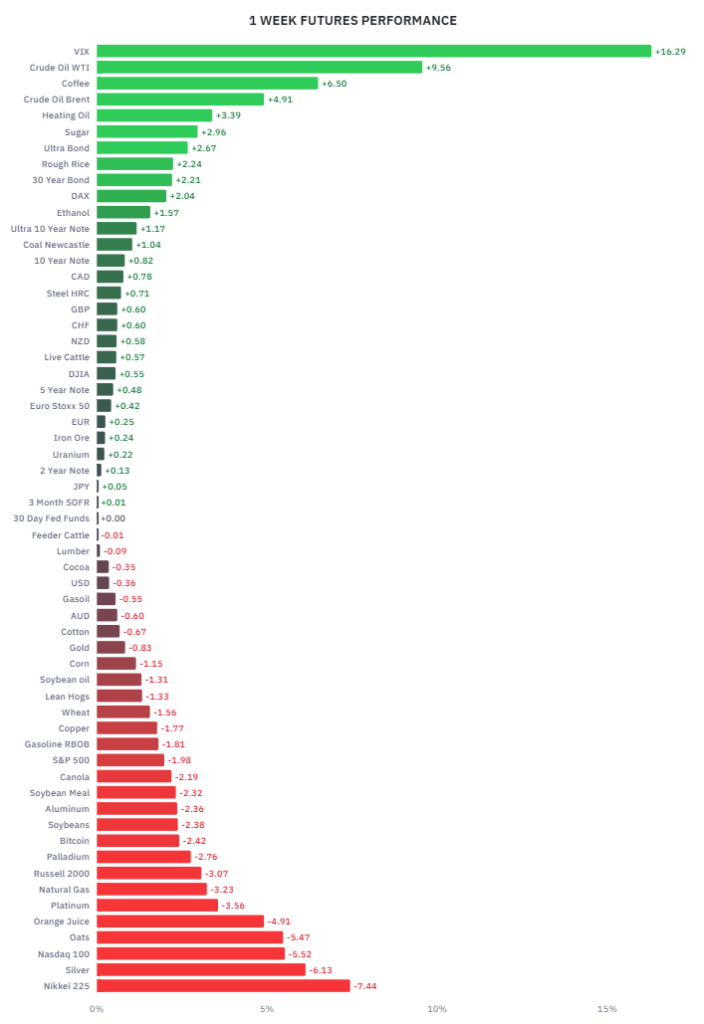
Energy led commodity gains with WTI rising over 9% while volatility surged, equity markets fell sharply led by the Nasdaq and Nikkei, and agricultural futures were mixed with coffee higher and grains weaker.
Energy markets led gains, with WTI crude rising +9.56% and Brent gaining +4.91%, while volatility surged +16.29%. Agricultural markets were mixed, with coffee (+6.50%) and sugar (+2.96%) outperforming wheat (-1.56%), canola (-2.19%) and soybeans (-2.38%). Equity markets weakened sharply, led by the Nikkei (-7.44%)and Nasdaq 100 (-5.52%). The divergence between rising energy prices and falling equities reflects growing inflation concerns and deteriorating risk appetite.
ASX Weekly Heatmap
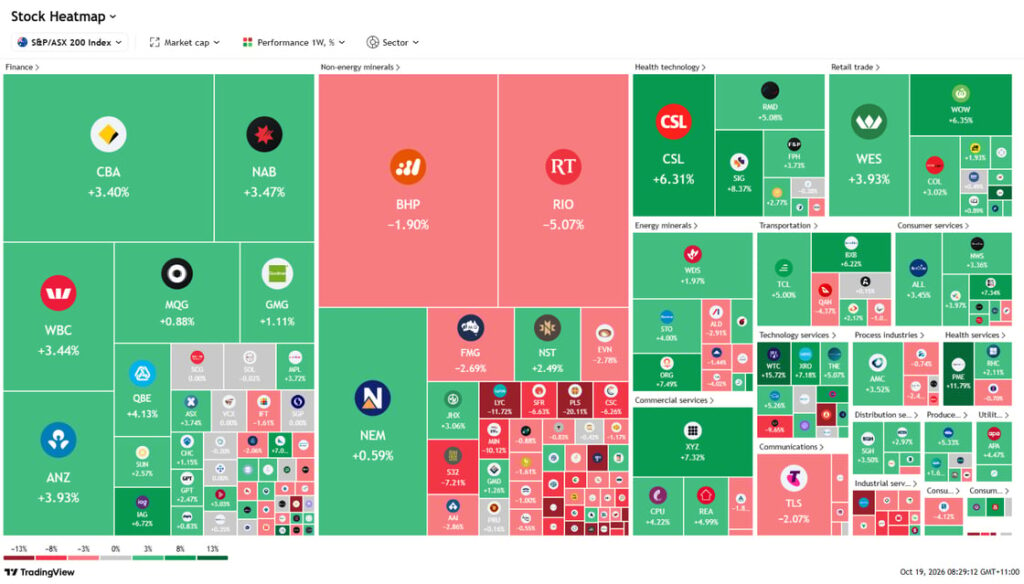
The ASX showed resilience relative to global peers with the major banks and CSL all gaining strongly, while BHP, Rio Tinto and technology names faced selling pressure amid weaker commodity prices and global risk-off sentiment.
Australian equities showed considerable divergence, with financials outperforming resources. Commonwealth Bank (+3.40%), NAB (+3.47%), Westpac (+3.44%) and ANZ (+3.93%) advanced, while BHP (-1.90%) and Rio Tinto (-5.07%) declined. Healthcare performed strongly, led by CSL (+6.31%), while Wesfarmers gained +3.93%. Technology and smaller resource companies experienced greater selling pressure, reflecting selective investor positioning despite weakness across global equity markets.
If any of this week’s developments raise questions about your portfolio, please get in touch.
Related Insights

The Federal Reserve, Bank of Japan and RBNZ all raised interest rates this week in a synchronised gl...

Drone attacks on Saudi Arabia's East-West oil pipeline drove fuel prices sharply higher this week, c...

Australian GDP beat expectations and US payrolls surged to 162K this week, reviving the prospect of...