
Photo by Enguerrand Photography on Unsplash
A global markets summary, for
Australian investors
A week of significant central bank decisions and softer economic data shifted the mood across global markets, with domestic inflation, US growth and Federal Reserve positioning all moving in ways that matter for Australian investors.
Five Key Developments:
1. Trump calls off planned strikes on Iran, only if a deal is done rapidly
President Trump postponed planned military strikes against Iran after confirming diplomatic negotiations had resumed, while making it clear military action would proceed if a deal was not reached quickly. The announcement reduced the immediate risk of a broader Middle East conflict and improved market sentiment, particularly across global energy markets. However, the situation remains highly fluid, with oil prices and geopolitical risk premiums likely to remain sensitive to any deterioration in negotiations.
2. Australian CPI contracts by -0.1% m/m vs 0.2% expected
Australian inflation unexpectedly declined over the month, providing further evidence that domestic price pressures continue to ease. The softer result strengthens the view that the RBA has likely completed its tightening cycle, with financial markets increasingly expecting interest rate cuts over the coming quarters should inflation continue trending towards the Bank’s target range. The result is supportive for interest-rate-sensitive sectors, including banks, property and consumer discretionary companies.
3. US Federal Reserve leaves rates unchanged at 3.75%
The Federal Reserve kept interest rates unchanged for a fifth consecutive meeting, but the decision was considerably more hawkish than markets had anticipated. Three FOMC members voted in favour of an immediate rate hike, highlighting ongoing concerns that inflation remains too persistent despite moderating economic growth. The outcome reinforces the view that policymakers are in no rush to ease monetary policy, with future decisions remaining highly dependent on inflation and labour market data.
4. Bank of England leaves rates steady at 3.75%
The Bank of England also left interest rates unchanged, despite acknowledging that higher energy prices and geopolitical tensions could lift inflation over coming months. While several policymakers favoured another increase, the majority judged that existing policy settings remain sufficiently restrictive. The decision provides greater certainty for businesses and households while reinforcing that any future easing is likely to be gradual rather than immediate.
5. US Advance GDP q/q rises 1.5%, lower than the prior 2.1%
The US economy continued to expand during the quarter, although growth slowed from the previous reading of 2.1%. The moderation suggests higher interest rates are gradually cooling economic activity without pushing the economy into recession. While the result points to slower momentum, continued positive growth supports the view that the US economy remains resilient, allowing the Federal Reserve to remain patient before considering policy changes.
Australian Focus: Australian CPI and RBA Cuts
The week’s domestic inflation surprise was the headline, but the broader picture across all five developments tells a coherent story. Australian CPI contracting 0.1% against a backdrop of a hawkish Fed hold, slowing US GDP and stalling Iran negotiations creates a genuine divergence between domestic and global rate trajectories. The RBA now looks increasingly likely to be done tightening while the Fed remains on alert.
For Australian investors, that divergence played out directly on the ASX, with banks and healthcare leading strongly as rate-sensitive sectors repriced for a more accommodative domestic outlook. The Bank of England holding with dissent in favour of hikes reinforces that Australia is ahead of the curve on disinflation, which supports the case for domestic equities over global peers in the near term.
Australian Agricultural Wrap Up
Australian agricultural markets remained relatively resilient over the week, with local grain prices continuing to hold firm despite mixed conditions across global commodity markets. ABARES reported APW Wheat at approximately A$404/t, ASW Wheat at A$397/t, Feed Barley at A$375/t, Grain Sorghum at A$433/t and Canola around A$829/t. Australian cotton also remained well supported at approximately A$630 per bale, while livestock prices continued to perform strongly, with the Eastern Young Cattle Indicator holding near 990¢/kg cwt and Trade Lamb remaining above 1,190¢/kg cwt. Competitive export demand, a favourable seasonal outlook and generally good production conditions continue to provide support for Australian producers heading into the second half of the year.
Futures Market Performance
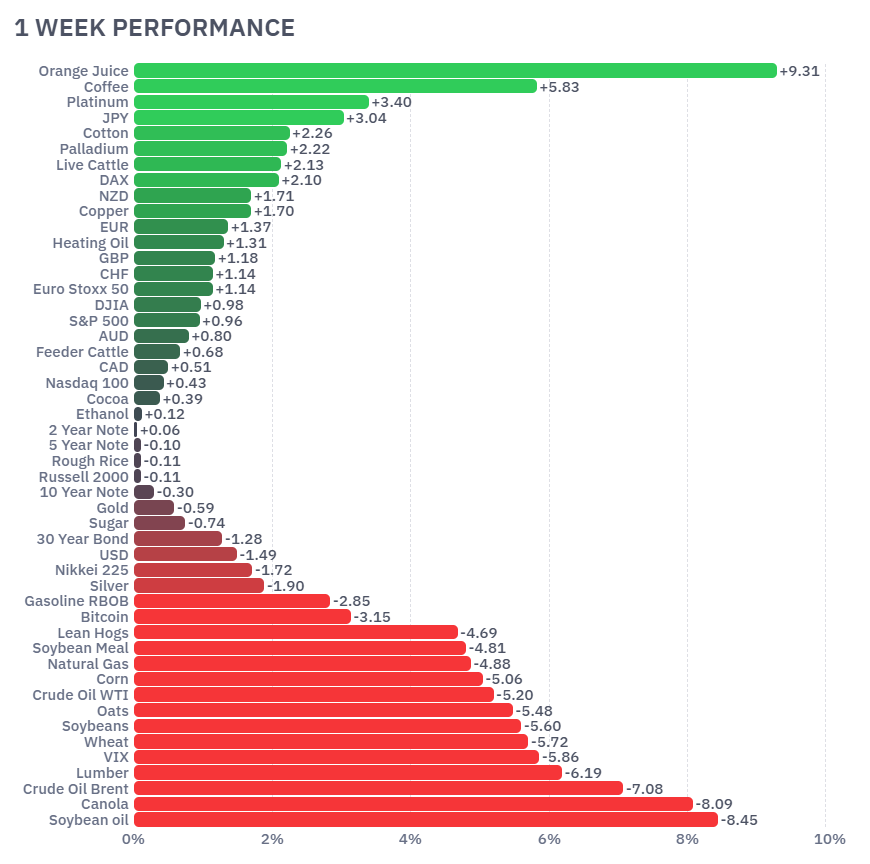
Energy markets weakened with Brent and WTI both falling sharply, while natural gas led gains alongside oilseeds and equity markets finished the week higher with the Nikkei, Nasdaq and Russell 2000 all advancing.
Global commodity markets were more mixed. Energy markets outperformed, led by Natural Gas (+8.90%), while Soybean Oil (+5.06%) and Canola (+1.43%) both posted gains, providing support for oilseed markets. Equity markets were also constructive, with the Nikkei (+4.57%), Nasdaq (+2.86%) and Russell 2000 (+1.82%) all finishing higher. However, several agricultural futures weakened, including Wheat (-5.53%), Corn (-3.56%), Oats (-1.98%) and Sugar (-4.35%), while Brent Crude (-11.13%) and WTI Crude (-9.57%) declined sharply as geopolitical risk premiums eased following progress in Middle East negotiations. Overall, Australian agriculture continues to compare favourably against global markets, with domestic cash prices remaining resilient despite ongoing volatility in international futures.
ASX Weekly Heatmap
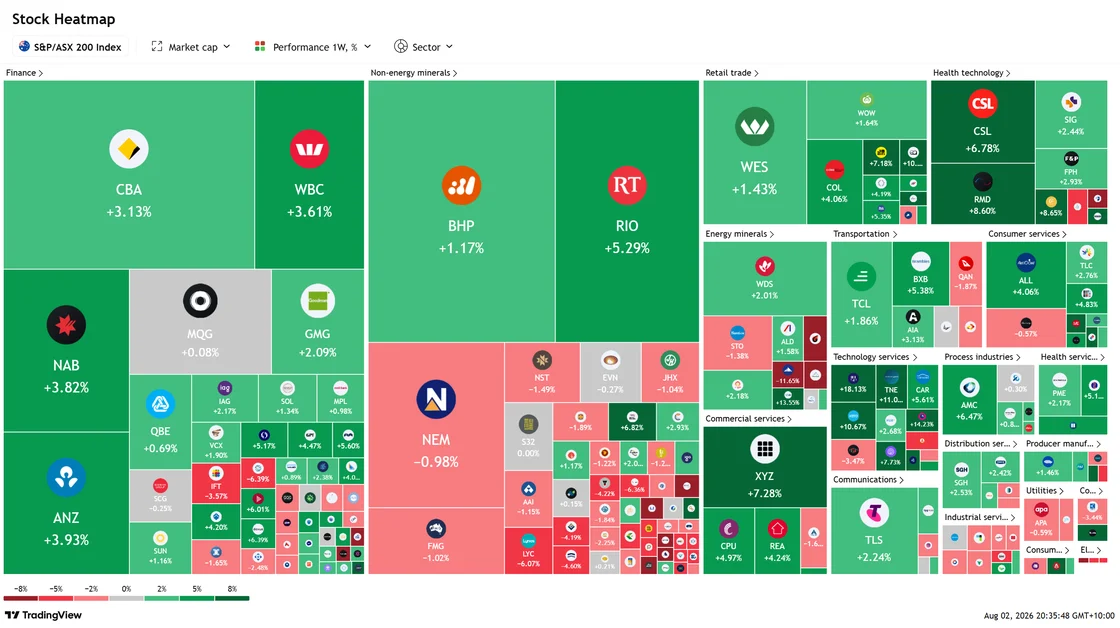
The ASX delivered a strong week led by banks and healthcare as softer Australian CPI lifted rate cut expectations, while resources were mixed and Xero surged following a strong earnings result.
The Australian sharemarket delivered another solid week, led by the financial sector as softer inflation and growing expectations that the RBA has completed its tightening cycle continued to support sentiment. The major banks outperformed, with ANZ (+3.93%), NAB (+3.82%), WBC (+3.61%) and CBA (+3.13%) all posting strong gains. Healthcare was also stronger, led by ResMed (+8.65%) and CSL (+6.78%), while Xero (+18.13%) surged following a strong earnings update. Resource stocks were more mixed, with Rio Tinto (+5.29%) outperforming, while weakness persisted across lithium producers. Overall, the market continues to broaden beyond financials, providing a more supportive backdrop for Australian equities.
If any of this week’s developments raise questions about your portfolio, please get in touch.
Related Insights

Australia's unemployment rate hit its highest post-COVID level and Trump rejected Iran's Hormuz reop...

The Federal Reserve, Bank of Japan and RBNZ all raised interest rates this week in a synchronised gl...

Drone attacks on Saudi Arabia's East-West oil pipeline drove fuel prices sharply higher this week, c...