
Photo by Oliver Herrmann on Unsplash
A global markets summary, for
Australian investors
Australian unemployment rose to 4.5% and wages continued to moderate this week, while the US Treasury’s doubling of long-dated bond buybacks triggered a significant market reaction including a sharp Bitcoin rally and a stabilisation in bond yields.
Five Key Developments:
1. Canadian CPI rises 0.5% m/m vs prior reading of -0.4%
Canadian inflation rebounded sharply in July, with headline CPI rising 0.5% m/m and 3.0% y/y, up from 2.8% annually in June. Higher gasoline prices were the major contributor, increasing 25.7% from a year earlier amid continued Middle East tensions. However, underlying inflation remained considerably more contained, suggesting much of the headline acceleration continues to be driven by energy rather than broad-based price pressures.
2. Australian Wage Price Index rises 0.8% q/q
Australian wages increased 0.8% in the June quarter and 3.2% over the year, confirming wage growth remains relatively firm but is continuing to moderate. The result is important for the RBA as it assesses whether domestic inflation pressures are easing sufficiently. Combined with the weakening labour market, the data provides a somewhat more balanced outlook for wages and inflation heading into the second half of the year.
3. US Treasury doubles long-dated bond buybacks
The US Treasury announced it will double the maximum size of its long-dated Treasury buybacks from US$2 billion to US$4 billion per operation, covering maturities between 10 and 30 years. The announcement helped stabilise a bond market that had experienced significant selling pressure, with the 30-year yield subsequently recording its largest daily decline since October. The program is aimed primarily at improving liquidity rather than representing conventional monetary stimulus.
4. Australian unemployment rate rises to 4.5%
Australia’s unemployment rate increased to 4.5% in July, with employment falling by 15,800 and the employment-to-population ratio declining. This provides further evidence that the Australian labour market is gradually cooling after an extended period of strength. Combined with moderating wage growth, the result should reduce some pressure on the RBA to continue tightening monetary policy, although inflation remains the key consideration for upcoming decisions.
5. European PMI readings broadly positive
European economic data surprised positively, with the Eurozone Composite PMI increasing to 52.1, its strongest reading since November. Manufacturing was the standout, rising to 52.8 from 51.9, while Services remained expansionary at 51.7. New orders grew at their fastest pace in more than three years and employment increased for the first time this year, providing encouraging evidence that economic momentum across Europe is beginning to improve.
Australian Focus: Australian Unemployment and Wages Signal a Turning Point
The two domestic data points this week told a consistent story. Australian unemployment rising to 4.5% with employment actually falling by 15,800, combined with wages moderating to 3.2% annually, gives the RBA a clearer picture that the tightening cycle is doing its work. The labour market that had remained stubbornly tight through much of the year is now showing genuine signs of cooling, which reduces the urgency for further hikes without yet making the case for cuts.
For Australian investors, that shift played out sharply on the ASX. Banks were sold aggressively as weaker employment data and changing rate expectations weighed on the sector, with NAB, CBA and Westpac all falling heavily. The rotation into resources was the other side of that trade, with BHP, Rio and Newmont all rallying strongly on firmer commodity prices. CSL surging 23.56% was the standout individual move of the week, lifting healthcare and providing significant index support. The US Treasury’s bond buyback announcement added a global dimension, stabilising long-dated yields and triggering the Bitcoin short squeeze, while improving European PMI data rounded out a week where the macro picture shifted more than the headline index move suggests.
Australian Agricultural Wrap Up
Australian agricultural markets were broadly stronger this week. APW Wheat rose 1% to A$402/t, ASW Wheat gained 1% to A$396/t, Feed Barley eased 1% to A$370/t, Canola held at A$778/t and Sorghum remained at A$432/t. Livestock was also positive, with the EYCI rising 1% to 924¢/kg cwt, Trade Lamb up 1% to 1,193¢/kg and Mutton up 2% to 835¢/kg, while live export cattle were 440¢/kg lwt, up 26% year-on-year. Wool eased 3% to 1,812¢/kg clean, while the Cotlook Cotton Index rose to 95.7 US¢/lb (+1%).
Futures Market Performance
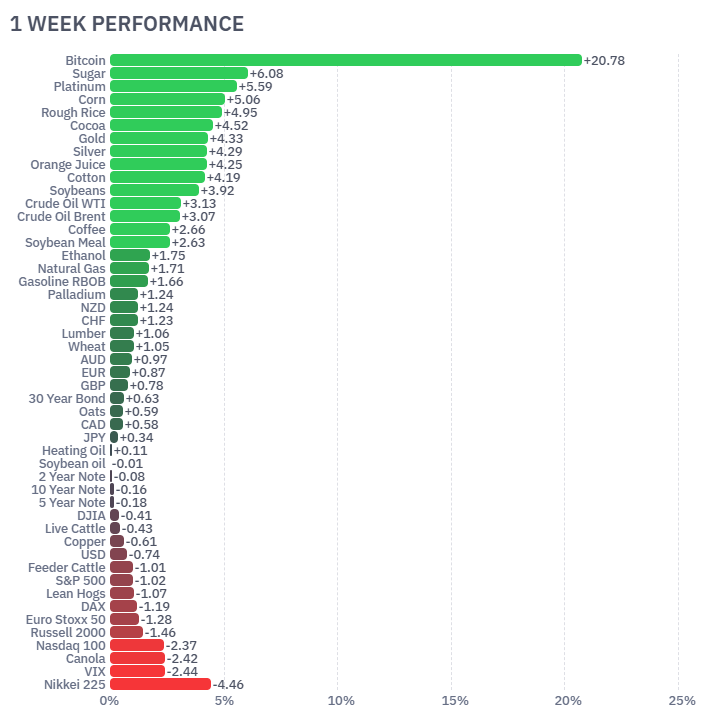
Agricultural commodities and precious metals led global gains while equity markets weakened, with Bitcoin surging over 20% following the US Treasury’s bond buyback announcement.
Globally, agricultural commodities rallied strongly, with Sugar (+6.08%), Corn (+5.06%), Rough Rice (+4.95%), Cotton (+4.19%), Soybeans (+3.92%) and Coffee (+2.66%) all advancing. Precious metals were another standout, with Platinum (+5.59%), Gold (+4.33%) and Silver (+4.29%), while crude oil gained around +3%. The major weakness was concentrated in equity markets rather than commodities, with the Nikkei falling -4.46%.
Bitcoin (+20.78%) was the standout performer, surging after the US Treasury increased its long-dated bond buyback program, which pushed yields lower and improved liquidity expectations. The initial rally triggered a major short squeeze, with approximately US$2.7 billion of short positions liquidated in 24 hours, while renewed momentum towards clearer US cryptocurrency regulation provided additional support.
ASX Weekly Heatmap
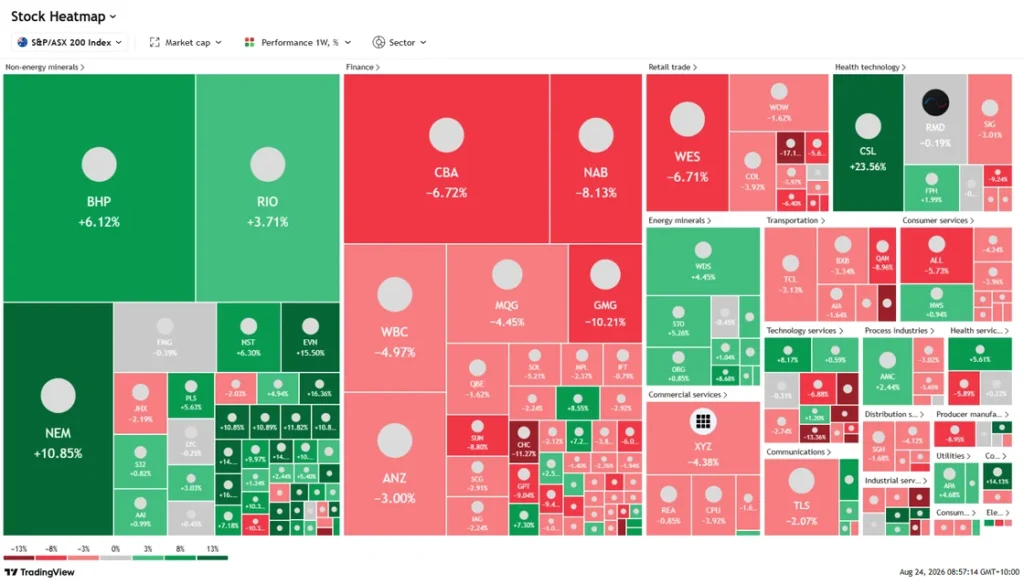
The ASX saw sharp rotation with resources and healthcare surging while banks sold off heavily, as weaker employment data and changing rate expectations drove significant sector divergence.
The Australian sharemarket experienced a significant rotation this week, with resources rallying strongly while financials sold off aggressively. BHP (+6.12%), Rio Tinto (+3.71%) and Newmont (+10.85%) benefited from stronger commodity prices, while a number of smaller miners recorded double-digit gains. In contrast, the banks were heavily sold, led by NAB (-8.13%), CBA (-6.72%) and WBC (-4.97%), as weaker employment data and changing rate expectations weighed on the sector. CSL (+23.56%) was the standout elsewhere in the market, helping healthcare outperform despite weakness across several other major sectors.
If any of this week’s developments raise questions about your portfolio, please get in touch.
Related Insights

Australia's unemployment rate hit its highest post-COVID level and Trump rejected Iran's Hormuz reop...

The Federal Reserve, Bank of Japan and RBNZ all raised interest rates this week in a synchronised gl...

Drone attacks on Saudi Arabia's East-West oil pipeline drove fuel prices sharply higher this week, c...