
Photo by Louis Meeckers on Unsplash
A global markets summary, for
Australian investors
The RBA held rates steady and US inflation data came in contained, but softening US retail sales and weak mortgage demand from Australia’s major banks delivered the more telling signals about where economic momentum is heading.
Five Key Developments:
1. RBA holds interest rates steady at 4.35%
The RBA left the cash rate unchanged at 4.35%, following 75bps of tightening earlier this year. The Board reiterated that inflation remains too high and that policy needs to remain restrictive, but the decision to pause suggests it is assessing the impact of previous increases. The RBA remains highly data-dependent, with inflation and labour-market conditions central to the next move.
2. US Core CPI rose to 0.2% m/m
US core CPI increased 0.2% m/m in July, following no change in June, while annual core inflation was 2.5%. Shelter increased only 0.1%, although medical care and airfares provided some upward pressure. The relatively contained underlying inflation reading helped ease immediate concerns around another Federal Reserve hike and supported US equities during the week.
3. British GDP rose to 0.3% m/m vs 0.0% prior
UK GDP expanded 0.3% m/m in June, improving from zero growth in May and a 0.1% contraction in April. Services were the principal driver, rising 0.4%, while production declined. The result points to a modest improvement in UK economic momentum, although growth remains relatively subdued and elevated borrowing costs continue to constrain domestic demand.
4. US Core PPI dropped to 0.2% from 0.4% prior
US producer-price pressures moderated in July, with final-demand services increasing 0.2% while the headline PPI was unchanged over the month. The softer producer inflation data reinforced the more benign message from CPI, reducing fears of a renewed acceleration in underlying inflation and helping markets lean towards the Federal Reserve remaining on hold rather than delivering further near-term tightening.
5. US Retail sales contracted by -0.6%
US retail sales unexpectedly declined 0.6% m/m in July, the first fall in nine months and the largest decline in 14 months. Online and auto sales were particularly weak, while the GDP-relevant control measure fell -0.4%. Combined with softer inflation, the result suggests US consumer momentum is cooling and reduces pressure on the Fed to tighten further.
Australian Focus: RBA on Hold as Consumer Momentum Cools
The RBA holding at 4.35% was widely expected, but the week’s more revealing data points came from elsewhere. US retail sales contracting 0.6% in their sharpest monthly fall in over a year, combined with contained CPI and softer PPI, paint a picture of an economy where the tightening cycle is doing its job without triggering alarm. The UK returning to modest growth adds a further data point to the global picture of economies grinding through restrictive policy rather than breaking under it.
For Australian investors, the more immediate concern was the ASX’s worst week since April, driven not by macro surprises but by earnings-related repricing. Westpac reporting a 20% fall in mortgage applications and CBA’s record profit being overshadowed by softer mortgage demand signal that the domestic credit cycle is turning, which has direct implications for bank earnings going forward. Resources also weakened as copper and gold retreated, while energy held firm on fading hopes of a Hormuz resolution. The week was a reminder that during reporting season, company-level data can move markets as much as any macro print.
Australian Agricultural Wrap Up
Australian agricultural prices were mixed this week, with grain markets generally firmer while livestock prices softened. ABARES reported APW Wheat at A$397/t (+1%), ASW Wheat A$390/t (+1%), Feed Barley A$375/t (+1%), Sorghum A$432/t (flat) and Canola A$777/t (flat). ABARES tracks these as Australian domestic crop prices, alongside domestic livestock and fodder markets.
Livestock was weaker, with the EYCI falling -3% to 909¢/kg, while the National Mutton Indicator declined -3% to 818¢/kg and Trade Lamb was broadly steady at 1,169¢/kg. Live export cattle remained comparatively strong at 440¢/kg, around 26% above year-ago levels. Despite the weekly pullback, cattle and lamb prices remain relatively strong historically, while Australian grain prices have held firm heading toward spring.
Futures Market Performance
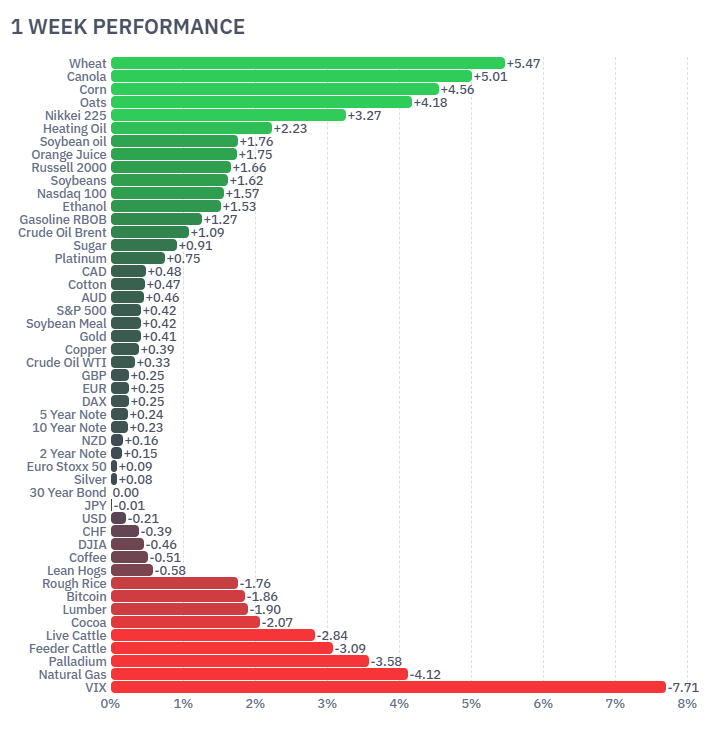
Agricultural commodities led gains with wheat, canola and corn all advancing strongly, while risk assets were broadly positive and the VIX fell sharply reflecting constructive market sentiment.
Risk assets were generally positive, with the S&P 500 +0.42%, Nasdaq 100 +1.57%, Russell 2000 +1.66% and Nikkei +3.27%. Agriculture was the standout: wheat +5.47%, canola +5.01%, corn +4.56% and oats +4.18%. Energy also strengthened, led by heating oil and gasoline, while Brent gained 1.09% on the supplied heatmap. Metals were mixed, Bitcoin fell 1.86%, and VIX dropped -7.71%, consistent with relatively constructive risk sentiment. Broader market data also showed the S&P 500 reaching a record during the week.
ASX Weekly Heatmap
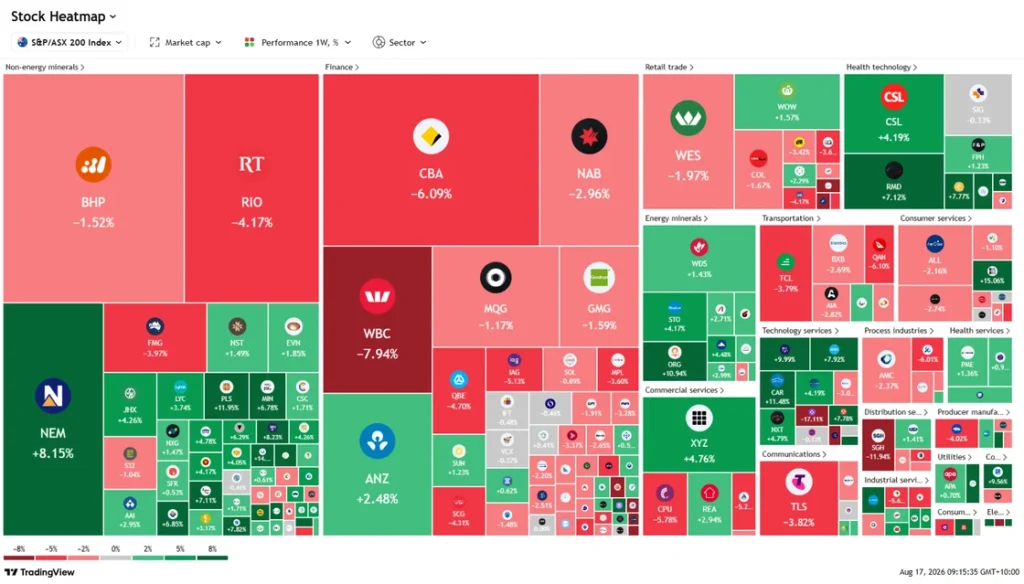
The ASX fell 1.6% in its worst week since April, with banks dragged lower by weak mortgage demand data and resources retreating on softer copper and gold prices, while energy and select technology names outperformed.
The ASX 200 fell -1.6% for the week, its worst performance since April, with weakness concentrated in banks and miners. Financials were the major drag after Westpac reported a 20% fall in mortgage applications, raising concerns about slowing housing credit growth, while CBA’s record profit was overshadowed by softer mortgage demand and rising credit costs. This drove WBC -7.94%, CBA -6.09% and NAB -2.96%.
Resources also weakened late in the week as copper and gold prices retreated and investors rotated out of commodities, leaving BHP -1.52%, Rio -4.17% and Fortescue -3.97% for the week. Offsetting this, energy gained around 2.8% as oil remained supported by fading hopes of reopening the Strait of Hormuz, while selected healthcare and technology stocks outperformed. Overall, the week’s decline was driven more by earnings-related repricing in heavyweight banks and miners than broad-based market weakness.
If any of this week’s developments raise questions about your portfolio, please get in touch.
Related Insights

Australia's unemployment rate hit its highest post-COVID level and Trump rejected Iran's Hormuz reop...

The Federal Reserve, Bank of Japan and RBNZ all raised interest rates this week in a synchronised gl...

Drone attacks on Saudi Arabia's East-West oil pipeline drove fuel prices sharply higher this week, c...