Photo by Heiko Janowski on Unsplash
A global markets summary, for
Australian investors
A hawkish Jackson Hole address from Fed Chair Warsh and a stronger-than-expected Australian CPI print dominated the week, reinforcing inflation concerns on both sides of the Pacific while agricultural commodities surged on supply disruption risks.
Five Key Developments:
1. Australian CPI rises 1.0% m/m ahead of expectations
Australian inflation surprised materially to the upside in July, with headline CPI rising 1.0% m/m, compared with expectations around 0.8%. Annual inflation eased from 3.8% to 3.5%, although trimmed mean inflation remained elevated at 3.6% y/y. The result reinforced concerns that domestic inflation remains sticky and increased expectations that the RBA may need to tighten policy further.
2. US Core PCE Price Index m/m steady at 0.2%
US Core PCE increased 0.2% m/m in July, unchanged from June and broadly in line with expectations. Core inflation remained 3.3% y/y, while headline PCE was 3.7%, demonstrating that inflation remains well above the Federal Reserve’s 2% objective. The monthly reading was relatively benign, but the persistence of annual inflation continues to limit the Fed’s ability to adopt a more accommodative policy stance.
3. US unemployment change steady at 203K
US initial jobless claims declined to 203,000 for the week ending 22 August, from a revised 207,000 and below expectations of approximately 208,000. Continuing claims also declined by 18,000 to just under 1.78 million. The data indicate that while US hiring has slowed, businesses are still reluctant to materially reduce headcount, leaving the labour market comparatively resilient.
4. Fed Chairman Warsh reiterated hawkish outlook
Fed Chair Kevin Warsh used his Jackson Hole address to reinforce the Fed’s focus on inflation, arguing that underlying inflation has not meaningfully improved and that financial conditions are not particularly restrictive. Markets interpreted the speech as hawkish, with expectations for a September rate increase rising sharply. Warsh stopped short of committing to a hike, instead emphasising that upcoming inflation and labour data would determine policy.
5. Canadian GDP expands 0.3%
Canadian GDP expanded 0.3% m/m in June, ahead of the 0.2% expected, marking a third consecutive monthly increase. More broadly, the economy rebounded strongly during the second quarter, expanding 0.8% q/q or 3.3% annualised, supported by stronger exports, consumer spending and business investment. The result reduces immediate concerns around recession and gives the Bank of Canada greater flexibility on interest rates.
Australian Focus: Sticky Inflation Keeps RBA and Fed on Alert
Australian CPI surprising to the upside at 1.0% m/m was the week’s most significant domestic development, and it arrived at an uncomfortable moment. Trimmed mean inflation holding at 3.6% annually confirms that underlying price pressures remain well above target, and the result has reignited expectations that the RBA may not yet be done tightening. That sits awkwardly against last week’s cooling labour market data, leaving the board facing a genuine tension between softening employment conditions and persistent inflation.
The global picture added pressure rather than relief. Fed Chair Warsh’s Jackson Hole address was unambiguously hawkish, with the Fed signalling that financial conditions are not yet restrictive enough and that a September hike is back on the table. US labour markets staying tight at 203K claims and Canadian GDP beating expectations round out a week where the disinflationary narrative took a step back globally. On the ASX, banks recovered ground following the prior week’s selloff while materials and energy retreated, with agricultural commodities the standout story as Black Sea supply disruption and adverse US weather drove wheat, corn and soybeans sharply higher.
Australian Agricultural Wrap Up
Australian agriculture was mixed despite the sharp rally in global grain futures. APW wheat rose 1% to A$409/t and ASW wheat gained 1% to A$400/t, while feed barley, canola and sorghum all eased slightly. Livestock diverged, with the EYCI rising 2% to 949¢/kg while trade lamb fell 3% to 1,153¢/kg and mutton slipped 1%. Recent rainfall of up to 50mm provided a timely boost across NSW cropping regions, although ABARES continues to flag below-median spring rainfall as a production risk for northern NSW and Queensland.
Futures Market Performance
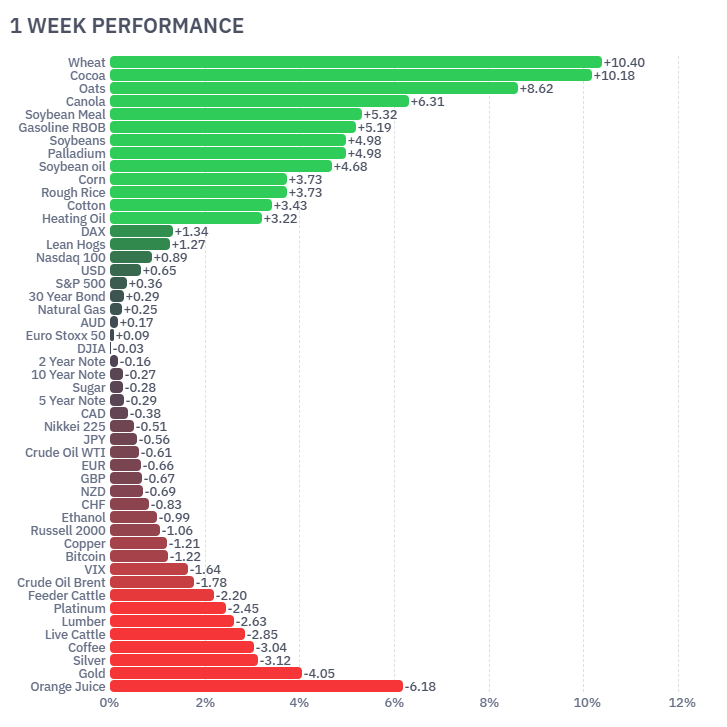
Agricultural commodities and precious metals led global gains while equity markets weakened, with Bitcoin surging over 20% following the US Treasury’s bond buyback announcement.
Agricultural commodities dominated the upside this week, with wheat +10.4%, cocoa +10.2%, oats +8.6%, canola +6.3%, soybean meal +5.3%, soybeans +5.0% and corn +3.7%. Equity markets were firmer, led by the DAX +1.3%, Nasdaq +0.9% and S&P 500+0.4%. Commodities were otherwise weak: orange juice -6.2%, gold -4.1%, silver -3.1%, coffee -3.0%, lumber -2.6% and platinum -2.5%. Crude oil also softened, with Brent down -1.8% and WTI down -0.6%.
Agricultural commodities rallied sharply as a combination of adverse US weather, tightening oilseed availability and renewed Black Sea supply disruption increased global crop risk. Wheat led grains higher as Russia–Ukraine attacks threatened Black Sea exports, while corn, soybeans and oats benefited from US heat and crop concerns. Cocoa surged on expectations of a delayed Côte d’Ivoire crop, highlighting continued vulnerability in West African supply.
ASX Weekly Heatmap
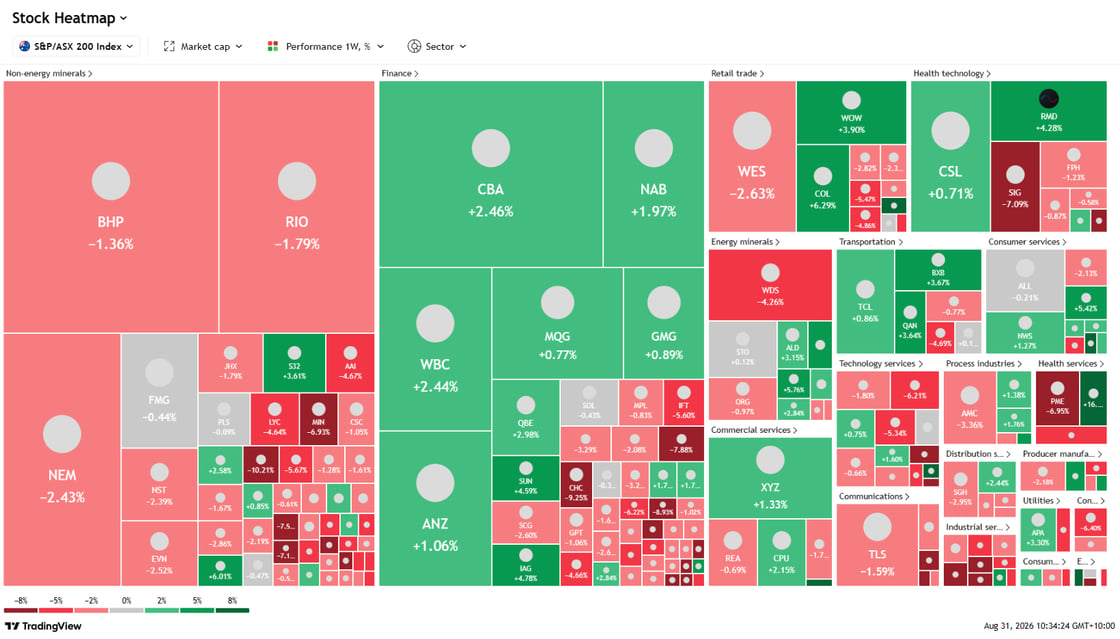
The ASX finished marginally higher with banks recovering strongly while materials, energy and consumer discretionary names retreated, reflecting ongoing sector rotation and inflation-driven repricing.
The ASX 200 finished the week approximately 0.4% higher, but performance was heavily divided by sector. Financials led, with CBA +2.5%, WBC +2.4%, NAB +2.0% and ANZ +1.1%. Materials were the major drag as BHP -1.4%, Rio Tinto -1.8% and Newmont -2.4% fell alongside weaker metals. Energy was also soft, led by Woodside -4.3%. Consumer performance was mixed, with Wesfarmers -2.6% contrasting with Woolworths +3.9%.
If any of this week’s developments raise questions about your portfolio, please get in touch.
Related Insights
Drone attacks on Saudi Arabia's East-West oil pipeline drove fuel prices sharply higher this week, c...

Australian GDP beat expectations and US payrolls surged to 162K this week, reviving the prospect of...

Australian unemployment rose to 4.5% and wages continued to moderate, signalling the labour market i...